
Compressed air, instrument air, nitrogen, vacuum
PPCH® FR Pneumatic Pipe and Fittings
A patented multi-layer pipe built for compressed air. A bigger bore at the same outside diameter, a smooth wall that never rusts, and fused joints with nothing to leak. The compressor works less for the same air at the tool.
FR stands for fibre-glass reinforced. Indian Patent No. 412111. PPCH is a registered trade mark, No. 3332845.
What changes on your plant
Leakage typically takes 20 to 30% of a compressor's delivered output. Threaded GI branches and push-fit O-rings relax with vibration and temperature swings. PPCH removes both.
- +23.5%
More air through the same size
Higher material strength allows a thinner wall at the same pressure class, so more of the pipe is bore: 50 mm against 45 mm at 63 mm OD, PN 16.
- 0.1–0.3 µm
Smooth, clean bore
A Hazen–Williams C of 145 to 150. No rust or scale is carried to valves, cylinders and tools.
- 0.135
Drier air
Wall conductivity in Btu/hr·ft·°F, against 43.66 for steel. Air stays above its dew point longer, so less condensate forms.
- Fused
Joints that don't age
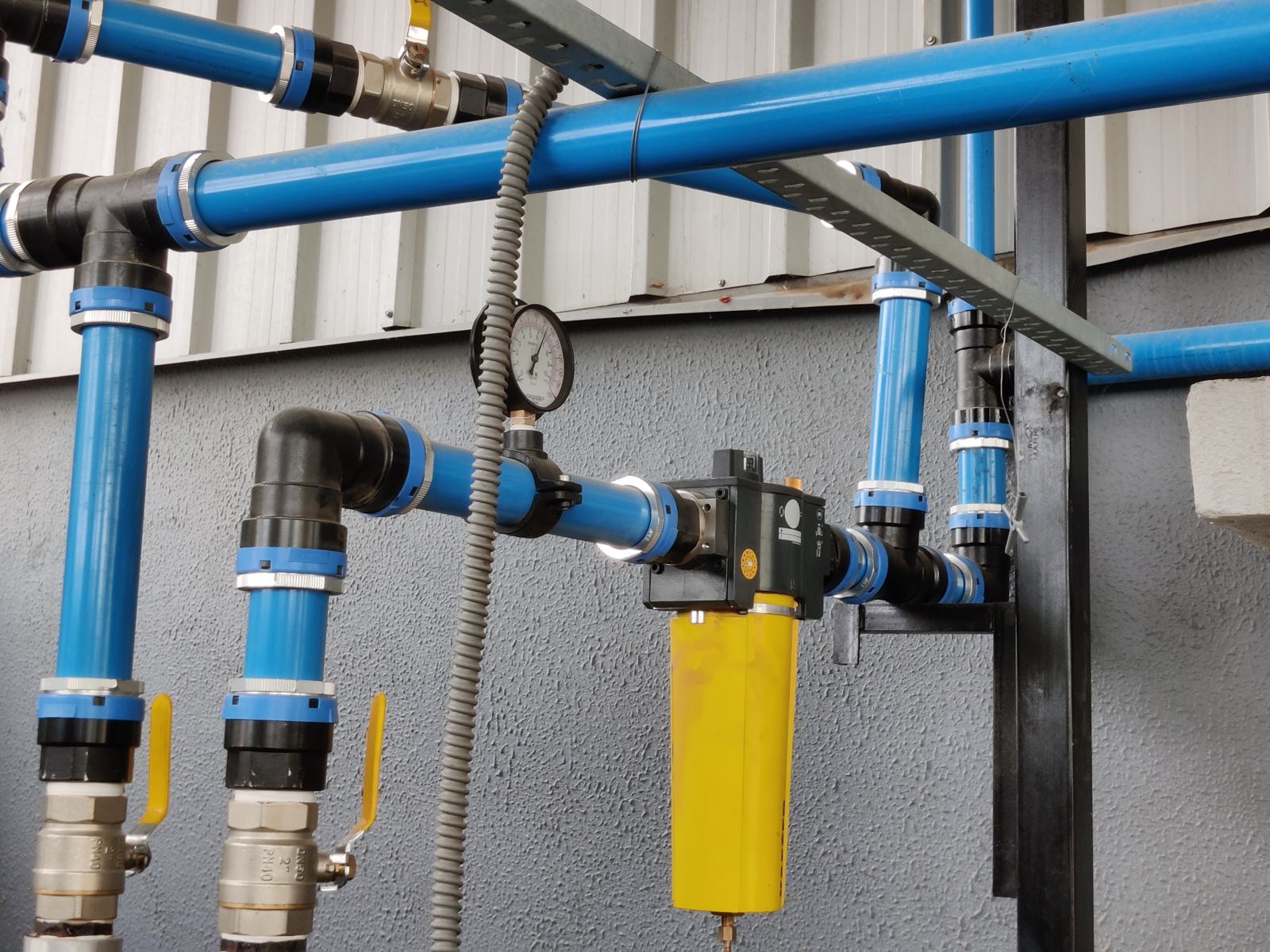
Socket fusion to 160 mm and electrofusion from 200 to 630 mm. No thread, O-ring or elastomer in the run: the joint is the same material as the pipe.
- 0.035
Fewer supports
Thermal expansion in mm/m·K, a quarter of plain PP. With a flexural modulus of 3000 MPa, the line sags less between hangers.
- 10–20 yrs
Outdoor-ready
A carbon UV outer layer for rooftop and yard runs. The blue strip codes the line as pneumatic at a glance.
Bore gained at the same outside diameter
Pick a size. A larger bore means lower air velocity, lower pressure drop and less compressor load for the same delivered air.
Compared at PN 16. Bores from the Anjney PPCH catalogue.
- PPR / PPRC bore
- –
- PPCH bore
- –
- More flow area
- –
Measured against the alternatives
Typical values from the Anjney PPCH catalogue and data sheet. For design work, confirm against the current data sheet.
| Parameter | PPCH | Aluminium | Metal (GI, MS, CI, SS) |
|---|---|---|---|
| Surface roughness, Ra | 0.1–0.3 µm | 0.7–1.0 µm | 1.0–1.7 µm |
| Hazen–Williams C | 145–150 | 130–135 | 130–135 |
| Joint type | Socket fusion, electrofusion | Push-fit with O-rings | Threaded or welded |
| Wall conductivity, Btu/hr·ft·°F | 0.135 | 27.09 | 43.66 |
| Corrosion | None | Corrodes | Corrodes and scales |
| Maintenance | Nil | O-ring joints need upkeep | Recurring |
| Parameter | PPCH | PPR / PPRC | What it means |
|---|---|---|---|
| MRS at 20 °C, 50 years | 12.5 MPa | 10 MPa | Thinner wall needed, so more bore |
| CRS at 70 °C, 50 years | 5.93 MPa | 3.2–3.6 MPa | Holds up near hot compressor rooms |
| Tensile strength at yield | 26 MPa | 24 MPa | Stiffer, less chance of breakage |
| Flexural modulus | 3000 MPa | 800 MPa | Less sag, fewer supports |
| Design stress | 4.3 MPa | 2.13 MPa | Margin behind the long-life rating |
| Life in direct sunlight | 10–20 years | 2–3 years | The carbon UV layer does the work |
Detailed comparisons: PPCH vs metal PPCH vs aluminium PPCH vs PPR
Specifications
From the PPCH technical data sheet.
| Pipe standard | ISO 15874-2:2012 |
|---|---|
| Fittings standard | DIN 16962 Parts 5 to 10 |
| Raw material | Classified to ISO 9080; MRS 12.5 MPa, CRS 5.9 MPa |
| Construction | Multi-layer: 60% glass fibre, 40% special-grade impact co-polymer |
| Colour | Blue identification strip, UV-resistant black outer layer |
| Pressure classes | PN 10 (SDR 11), PN 16 (SDR 7.4), PN 20 (SDR 6) |
| Sizes | 20–50 mm: PN 16, PN 20 63–630 mm: PN 10, PN 16, PN 20 |
| Temperature | −5 °C to +95 °C, per pipe selection chart |
| Thermal expansion | 0.035 mm/m·K |
| Thermal conductivity | 0.135 Btu/hr·ft·°F |
| Hydro pressure tests | To ISO 15874-2:2012 at 20 °C for 1 h and 95 °C for 22, 165 and 1000 h |
| Standard length | 5 m |
| Jointing | Socket fusion 20–160 mm, electrofusion 200–630 mm |
| Outside diameter | Approx. inner diameter |
|---|---|
| 63 mm | 50 mm |
| 75 mm | 65 mm |
| 90 mm | 78 mm |
| 110 mm | 95 mm |
| 160 mm | 138 mm |
| 200 mm | 173 mm |
| 250 mm | 216 mm |
| 315 mm | 270 mm |
Bores from the data sheet: 63 mm at PN 16, 75 mm and above at PN 10. Allowable pressure falls with temperature and years of service; see the life expectancy chart in Downloads.
PPCH fittings
Moulded fittings to DIN 16962, PN 25 up to 160 mm, plus electrofusion from 200 to 630 mm and threaded transitions for valves, filters and tools.
| Fitting | Jointing | PPCH range |
|---|---|---|
| Coupler | Socket fusion fittings | 20–160 mm, PN 25 |
| Elbow 90° | Socket fusion fittings | 20–160 mm, PN 25 |
| Elbow 45° | Socket fusion fittings | 20–160 mm, PN 25 |
| Long radius elbow | Socket fusion fittings | 20, 32, 50, 63 mm, PN 25 |
| Equal tee | Socket fusion fittings | 20–160 mm, PN 25 |
| Reducing tee | Socket fusion fittings | 20–160 mm, PN 25 |
| Reducer | Socket fusion fittings | 20–160 mm, PN 25 |
| Electrofusion coupler | Electrofusion fittings | 200–630 mm |
| Electrofusion elbow 90° | Electrofusion fittings | 200–630 mm |
| Electrofusion equal tee | Electrofusion fittings | 200–630 mm |
| Electrofusion core flange | Electrofusion fittings | 200–630 mm |
| Electrofusion reducer | Electrofusion fittings | 200 × 160 mm upward |
| Core flange (stub end, collar) | Flanges and branch connections | 20–160 mm, PN 25 |
| Step flange (backing ring) | Flanges and branch connections | 20–630 mm |
| Branch adaptor | Flanges and branch connections | All relevant sizes, up to 315 mm header |
| Male threaded adaptor | Threaded transition fittings | 20–63 mm × ½″–2″, PN 25 |
| Female threaded adaptor | Threaded transition fittings | 20–63 mm × ½″–2″, PN 25 |
| Threaded union, male and female | Threaded transition fittings | 20–63 mm × ½″–2″, PN 25 |
| Female threaded elbow and tee | Threaded transition fittings | 20 mm × ½″; 25 mm × ½″, ¾″; 32 mm × ¾″, 1″; PN 25 |
Where PPCH goes
Downstream of the aftercooler and dryer: ring mains, risers, headers and station drops.
- Plant compressed air: ring mains, headers and drops
- Instrument air: dry, clean, oil-free lines
- Nitrogen: inerting and blanketing lines
- Vacuum: suction and transfer lines
Confirm before specifying: compressor lubricant type, earthing and antistatic arrangement, and the fire classification of enclosed zones. We review these with you on every project.
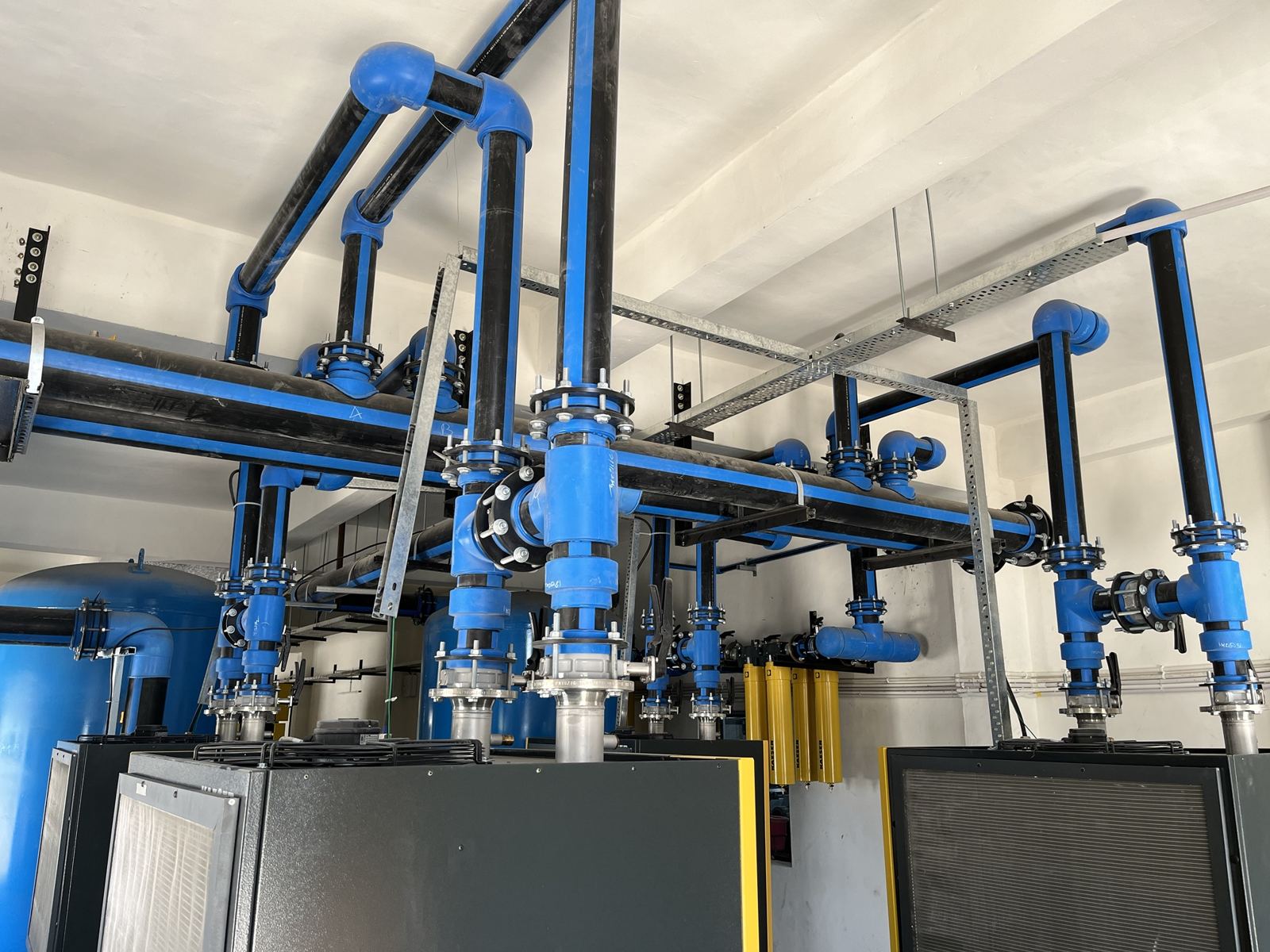
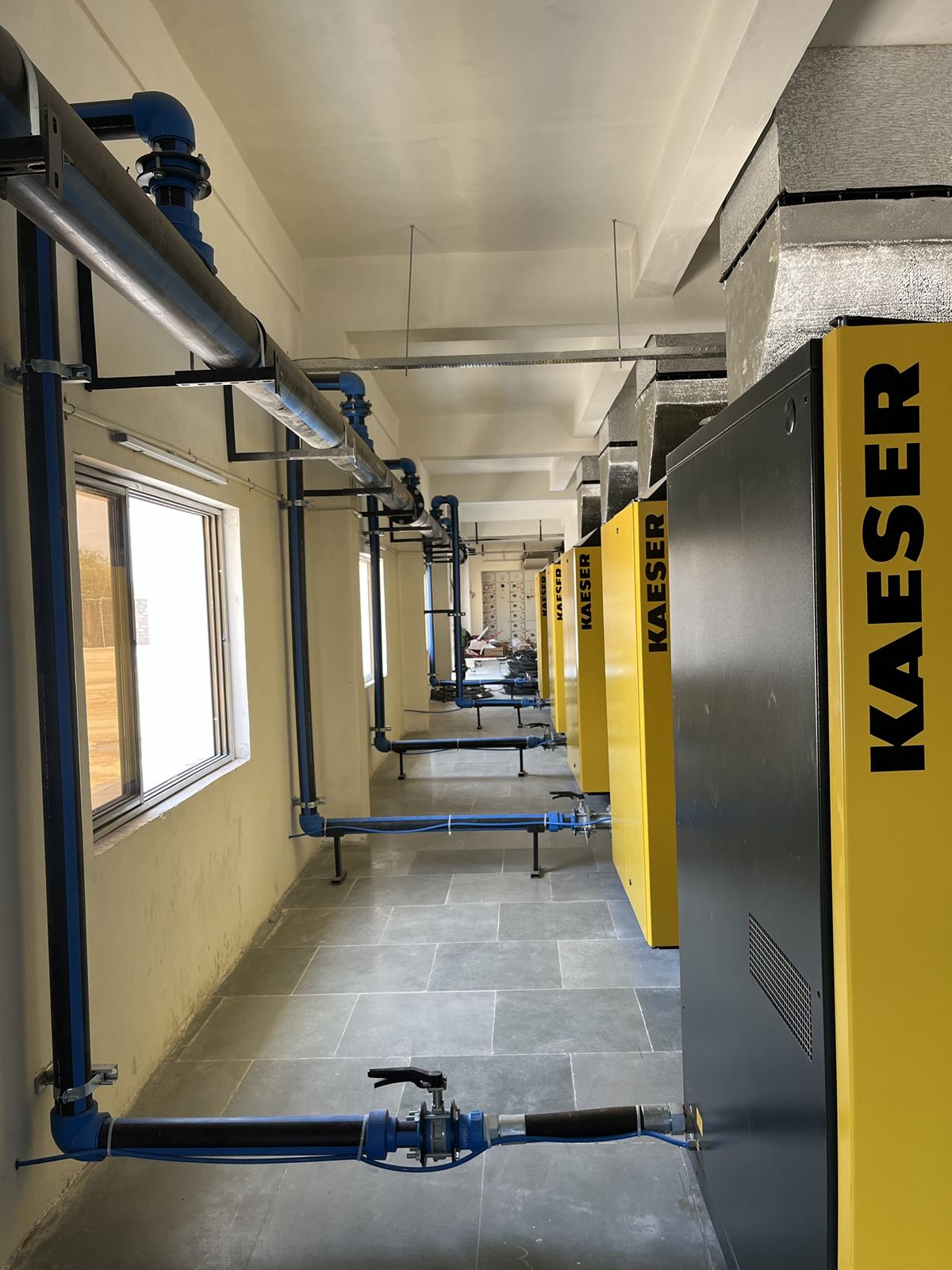
PPCH runs downstream of compressors from ELGI, Atlas Copco, Ingersoll Rand, Chicago Pneumatic, Kaeser, FS Curtis, Kirloskar Pneumatic, Gardner Denver and CompAir.
PPCH questions
What is PPCH pipe made of?
A multi-layer construction of 60% glass fibre and 40% special-grade impact co-polymer polypropylene: an inner layer, a glass-fibre reinforced core, a welding layer and a UV-resistant carbon black outer layer with a blue identification strip.
What sizes and pressure classes are available?
20 to 630 mm. Pipes from 20 to 50 mm come in PN 16 and PN 20; from 63 to 630 mm in PN 10 (SDR 11), PN 16 (SDR 7.4) and PN 20 (SDR 6). Moulded fittings up to 160 mm are rated PN 25.
How does PPCH save compressor energy?
Three ways: a larger bore at the same outside diameter, a smooth inner wall (Ra 0.1–0.3 µm) that does not scale, and fused joints with no leak path. Lower pressure drop and fewer leaks let the compressor deliver the same air at the tool with less work.
Can PPCH run outdoors?
Yes. The carbon black outer layer resists UV; the catalogue gives 10 to 20 years in direct sunlight, against 2 to 3 years for plain PPR. Life outdoors depends on exposure, so confirm with us for rooftop runs.
How is PPCH joined?
By socket fusion from 20 to 160 mm and by electrofusion from 200 to 630 mm. Threaded transition fittings connect valves, filters, gauges and tools. Jointing is electrically heated, so there is no open flame, gas cylinder or welding torch on site.
What should be checked before using PPCH?
Install PPCH downstream of the aftercooler and dryer. Confirm the compressor lubricant type, the earthing and antistatic arrangement, and the fire classification of any enclosed zone. We review these on every project.
PPCH downloads
- PPCH product catalogueRange, construction, technical evaluationPDF, 2.2 MB
- PPCH technical data sheetStandards, pressure classes, boresPDF, 30 KB
- Electrofusion technical noteJoint comparison, bead losses, procedurePDF, 5.1 MB
- Life expectancy chartPPRCT and PPCH allowable pressure by temperature and yearsPDF, 120 KB
- Patent certificate No. 412111Multi Layered PPCH Pipe, granted 2022PDF, 659 KB
Enquiry
Send us your line schedule
Tell us the service, pipe sizes and approximate run lengths. Our technical sales team sizes the network and returns a bill of material, with an installed-cost comparison against your current specification.
- Sales+91 93747 89875
- Office+91 79 4800 6581
- Emailmarketing@anjney.com
- Exportexport@anjney.com
- WhatsAppMessage us on WhatsApp