
Cooling, chilled, RO, DM, raw and hot water
PPRCT® FR Composite Pipe and Fittings
One material across the whole water block. Glass-fibre reinforced PP-RCT with a carbon UV shell replaces PP, PP-R and CPVC with a single specification, a bigger bore and a quarter of the thermal expansion.
FR stands for fibre-glass reinforced. PPRCT is a registered trade mark, No. 3676896.
One material for the water block
Most plants split water services between PP-R, PP and CPVC: three materials, three jointing methods and three spare inventories. PPRCT covers all of them.
- 95 mm
More bore, same trench
MRS 12.5 against 10 for standard PP lets the wall be thinner at the same pressure class: 95 mm of bore at 110 mm PN 10, against 90 mm.
- 35 mm
A quarter of the movement
A 40 m run at a 25 K temperature swing moves 35 mm, not the 150 mm plain PP would. Fewer loops and fewer supports.
- 2.58%
Outdoors without cladding
Carbon black content of the UV layer, measured by CIPET in 2025. Cooling-tower and roof runs need no cladding or repainting.
- 5.93 MPa
Holds up hot
Creep rupture strength at 70 °C, for hot condensate and high-temperature circuits where PP-R and CPVC derate.
- 1000 h
Tested at 95 °C
CIPET held PPRCT at 3.8 MPa hoop stress for 1000 hours at 95 °C to ISO 15874-2: no swelling, no bursting.
- 0 bead
Fused, not cemented
Socket fusion to 160 mm and electrofusion from 200 to 630 mm. No solvent-cement cure time and no bead in the bore.
Bore and flow area gained
Same outside diameter, compared with PP, PP-R and HDPE. Pick a size to see the difference to scale.
Bores at PN 16 from 20 to 63 mm and PN 10 from 75 to 315 mm, from the Anjney PPRCT catalogue. Pump power saving depends on layout, head, fittings and duty cycle.
- PP / PP-R / HDPE bore
- –
- PPRCT bore
- –
- More flow area
- –
Allowable operating pressure
From the Anjney life expectancy chart for PPRCT and PPCH pipe carrying water, safety factor 1.25. Choose temperature, years of service and pressure class.
Values outside the chart's range are not shown: above 70 °C the chart stops at 25 years, and at 95 °C at 5 years. The full chart, including thinner pipe series, is in Downloads.
Against what is specified today
Figures from the Anjney PPRCT catalogue and solar-plant technical note.
| Parameter | PPRCT FR Composite | PP / PP-R | CPVC |
|---|---|---|---|
| Design stress | 4.3 MPa | 2.13 MPa | Lower creep margin when hot |
| Bore at 110 mm, PN 10 | 95 mm | 90 mm | Comparable to PP-R |
| Thermal expansion | 0.035 mm/m·K | About 0.15 mm/m·K | About 0.062 mm/m·K |
| Direct sunlight | 10–20 years, carbon UV layer | 2–3 years; not permitted unprotected | Needs cladding; chalks and embrittles |
| Jointing | Socket fusion to 160 mm, electrofusion 200–630 mm | Butt weld leaves an internal bead | Solvent cement, cure time |
Detailed comparisons: PPRCT vs metal PPRCT vs HDPE PPRCT vs PPR
Specifications
From the PPRCT technical data sheet and CIPET test reports.
| Pipe standard | ISO 15874-2:2012 |
|---|---|
| Fittings standard | DIN 16962 Parts 5 to 10 |
| Raw material | Classified to ISO 9080; MRS 12.5 MPa, CRS 5.9 MPa |
| Construction | Multi-layer: 60% glass fibre, 40% PPRCT inner and upper layers |
| Colour | Green identification strip, UV-resistant black outer layer |
| Pressure classes | PN 10 (SDR 11), PN 16 (SDR 7.4), PN 20 (SDR 6) |
| Sizes | 20–50 mm: PN 16, PN 20; 63–630 mm: PN 10, PN 16, PN 20 |
| Temperature | −5 °C to +95 °C, per pipe selection chart |
| Surface roughness | Ra 0.1–0.3 µm; Hazen–Williams C 145–150 |
| Thermal conductivity | 0.135 Btu/hr·ft·°F |
| Third-party tests | CIPET: 1000 h at 95 °C, hoop stress 3.8 MPa, no swelling or bursting (report No. 306, 2017). CIPET: carbon black 2.58%, dispersion satisfactory, UV stabiliser present (report No. 5250, 2025) |
| Standard length | 5 m |
| Jointing | Socket fusion 20–160 mm, electrofusion 200–630 mm |
Life expectancy is stated at the rated duty for the service concerned and is not a warranty period.
PPRCT fittings
Moulded fittings to DIN 16962, PN 25 up to 160 mm, and electrofusion fittings from 200 to 630 mm. Threaded transition fittings are made for PPCH compressed-air lines only.
| Fitting | Jointing | PPRCT range |
|---|---|---|
| Coupler | Socket fusion fittings | 20–160 mm, PN 25 |
| Elbow 90° | Socket fusion fittings | 20–160 mm, PN 25 |
| Elbow 45° | Socket fusion fittings | 20–160 mm, PN 25 |
| Long radius elbow | Socket fusion fittings | 20, 32, 50, 63 mm, PN 25 |
| Equal tee | Socket fusion fittings | 20–160 mm, PN 25 |
| Reducing tee | Socket fusion fittings | 20–160 mm, PN 25 |
| Reducer | Socket fusion fittings | 20–160 mm, PN 25 |
| End cap | Socket fusion fittings | 20–160 mm, PN 25 |
| Electrofusion coupler | Electrofusion fittings | 200–630 mm |
| Electrofusion elbow 90° | Electrofusion fittings | 200–630 mm |
| Electrofusion equal tee | Electrofusion fittings | 200–630 mm |
| Electrofusion core flange | Electrofusion fittings | 200–630 mm |
| Electrofusion reducer | Electrofusion fittings | 200 × 160 mm upward |
| Core flange (stub end, collar) | Flanges and branch connections | 20–160 mm, PN 25 |
| Step flange (backing ring) | Flanges and branch connections | 20–630 mm |
| Branch adaptor | Flanges and branch connections | All relevant sizes |
Where PPRCT goes
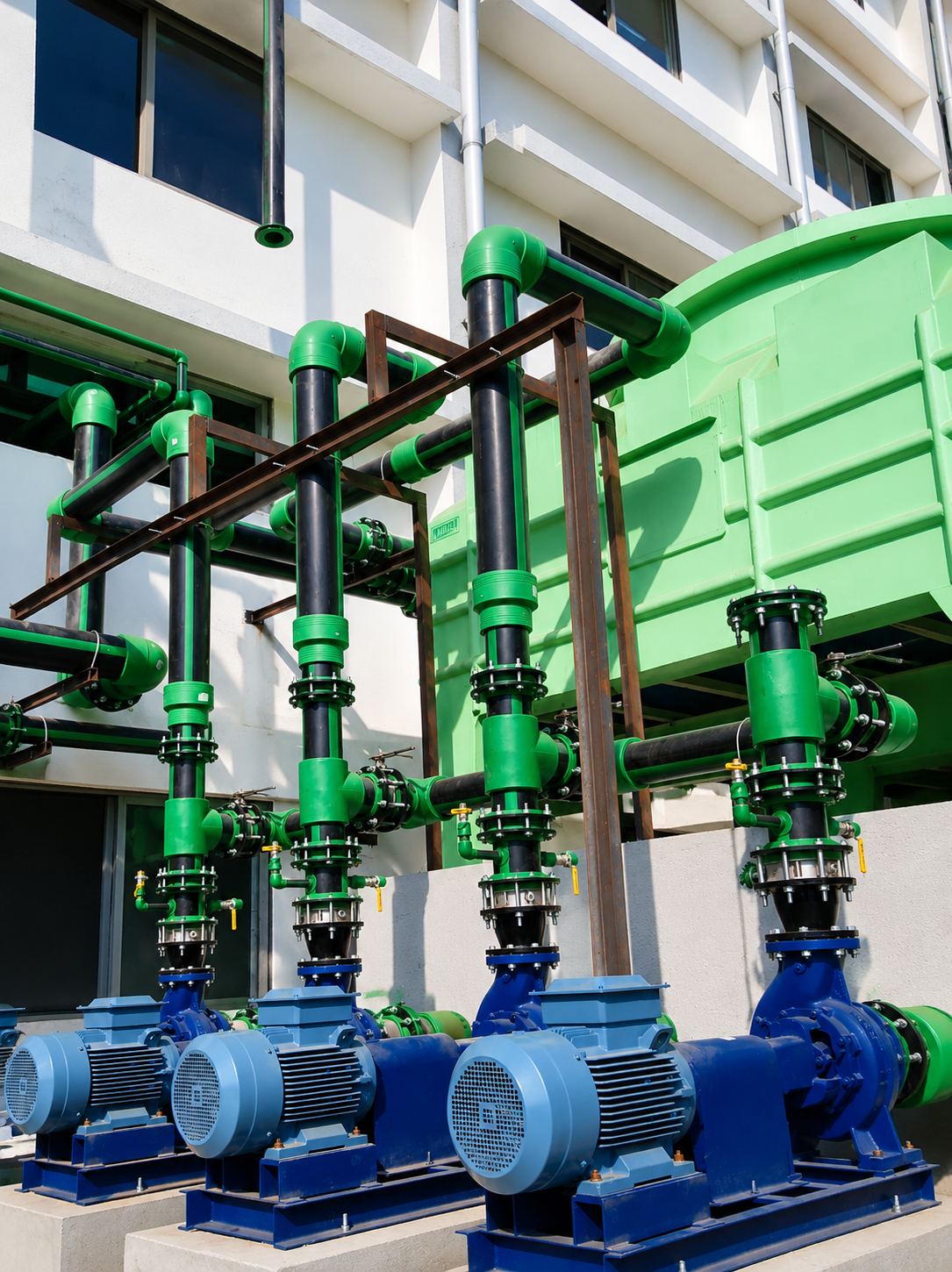
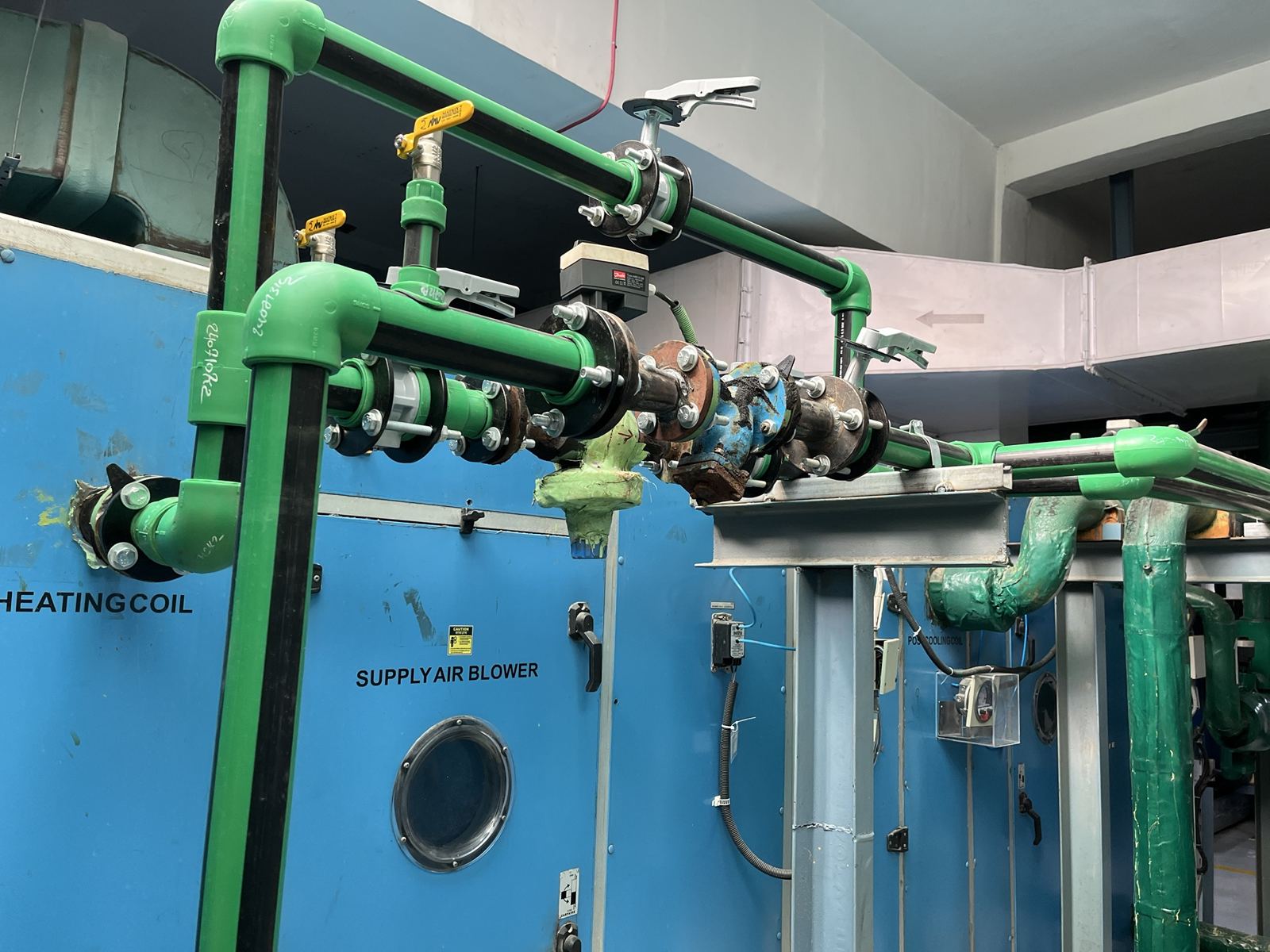
- Cooling and chilled water: headers, risers and distribution to process and chiller loads
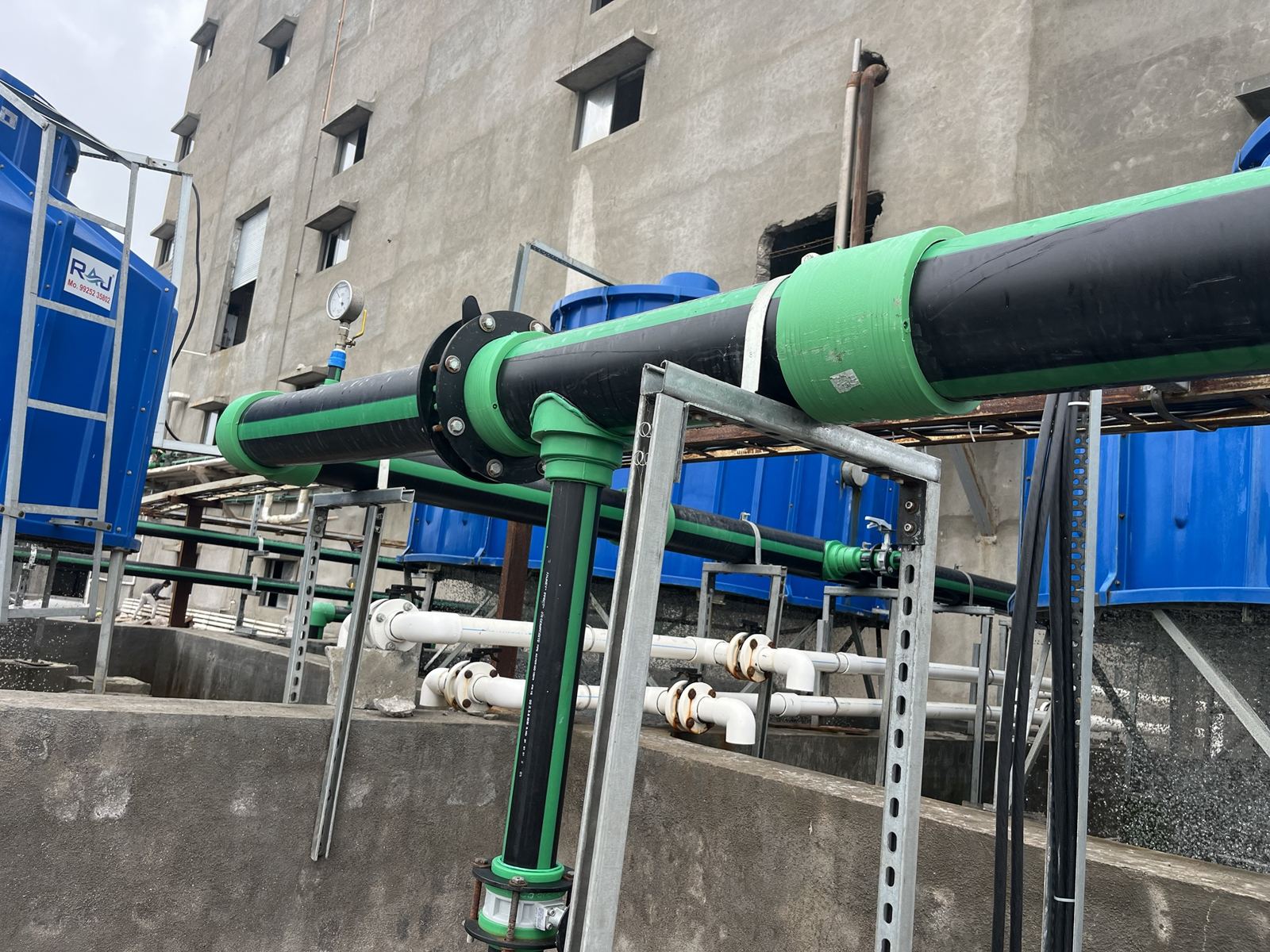
- Cooling towers, outdoors: supply and return on the carbon UV layer, no cladding
- Hot water and condensate: hot-water condensation return and high-temperature circuits
- Raw, city, soft, RO and DM water: incoming water, softeners, RO product and DM distribution
- ETP, WTP and process lines: consult us on fluid, concentration and temperature
We do not offer PPRCT for ultra-pure water polish loops; that loop stays in the material your UPW vendor specifies. For acids, alkalis and chemical drains, use PPH.
PPRCT questions
What is PPRCT pipe?
PPRCT FR Composite is a multi-layer pipe of 60% glass fibre and 40% PP-RCT (polypropylene random copolymer with modified crystallinity), with a UV-resistant carbon black outer layer and a green identification strip. It is made to ISO 15874-2:2012 in 20 to 630 mm.
What is the difference between PPR and PPRCT pipe?
PP-RCT has a higher minimum required strength (MRS 12.5 against 10 MPa) and a much higher creep strength when hot (5.93 against 3.2–3.6 MPa at 70 °C). The wall can be thinner at the same pressure class, so the bore is larger. Anjney adds a glass-fibre core that cuts thermal expansion to 0.035 mm/m·K and a carbon UV layer for outdoor runs.
Can PPRCT carry hot water?
Yes, from −5 to +95 °C, with allowable pressure falling as temperature rises. For example, from our life expectancy chart for water, PN 16 (SDR 7.4) pipe is rated 13.5 bar at 70 °C for 10 years of service. Use the pressure tool above for other cases.
Can PPRCT be installed in direct sunlight?
Yes. Its carbon black outer layer gives 10 to 20 years in direct sunlight, and CIPET measured 2.58% carbon black with satisfactory dispersion and UV stabiliser present. Plain PP-R is rated 2 to 3 years and is not permitted unprotected.
Is PPRCT suitable for chemicals?
PPRCT is used on ETP, WTP and some process lines, but suitability depends on the fluid, concentration, temperature and pressure together, so consult us first. For acids, alkalis and chemical drains we recommend PPH, and we do not recommend threaded fittings in chemical service.
How is PPRCT joined?
By socket fusion from 20 to 160 mm and electrofusion from 200 to 630 mm. Electrofusion leaves no bead in the bore, so there is no extra pump head at each joint and no edge for scale or biofilm.
PPRCT downloads
- PPRCT product catalogueRange, flow tables, comparisonPDF, 2 MB
- PPRCT technical data sheetStandards, pressure classes, boresPDF, 231 KB
- Life expectancy chartPPRCT and PPCH allowable pressure by temperature and yearsPDF, 120 KB
- Electrofusion technical noteJoint comparison, bead losses, procedurePDF, 5.1 MB
- PPRCT trade mark No. 3676896Class 17, registered 2017PDF, 145 KB
Enquiry
Send us your line schedule
Tell us the service, pipe sizes and approximate run lengths. Our technical sales team sizes the network and returns a bill of material, with an installed-cost comparison against your current specification.
- Sales+91 93747 89875
- Office+91 79 4800 6581
- Emailmarketing@anjney.com
- Exportexport@anjney.com
- WhatsAppMessage us on WhatsApp